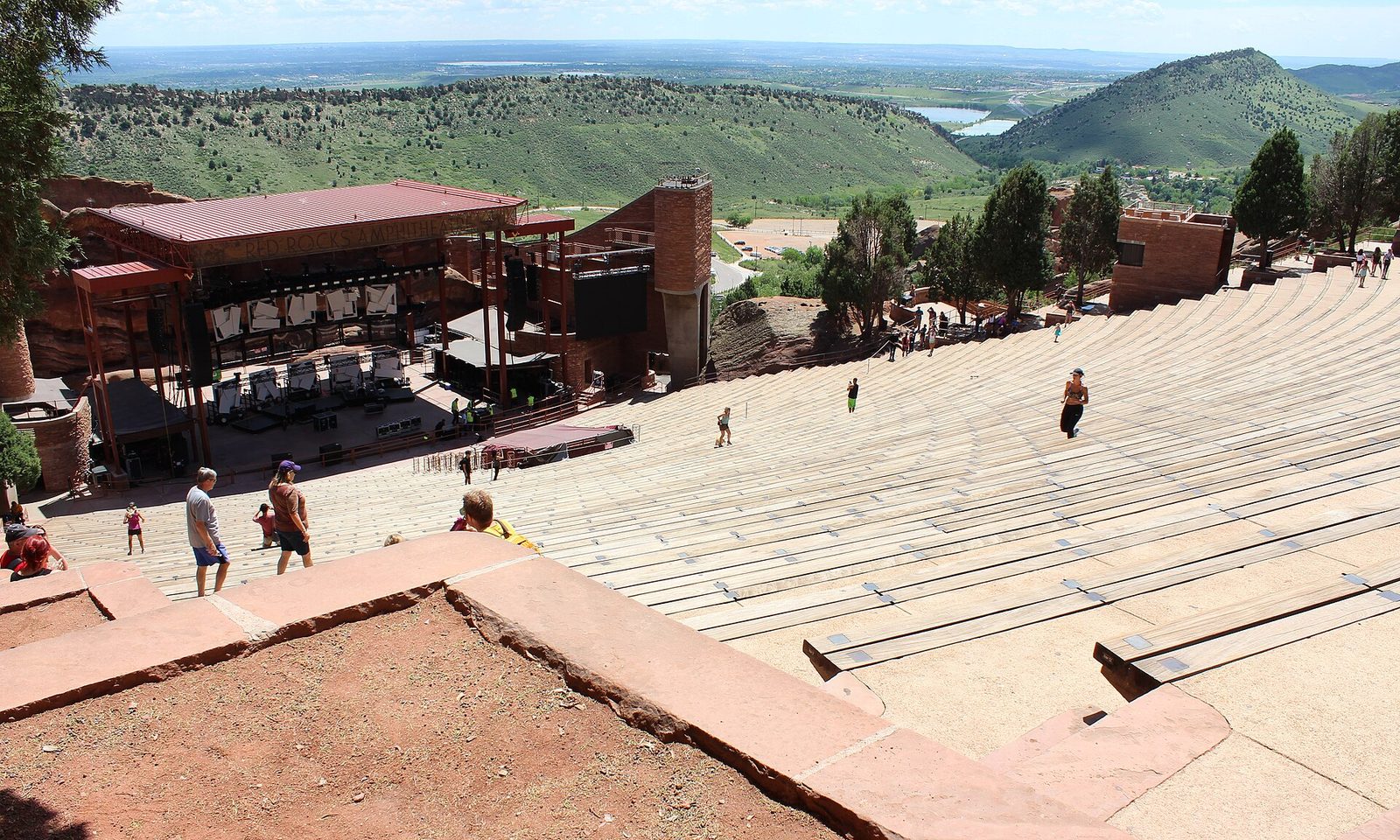
On a Tuesday morning in October there will be a hundred people running the steps of Red Rocks Amphitheatre, a dozen doing push-ups on the benches, someone filming a dance video on the stage, and nobody collecting money at the gate. This is the thing most visitors do not know about the most famous concert venue in North America: on any day without a show, the park, the amphitheatre, the Visitor Center and the Trading Post are all free to enter, and so is the parking. The ticketed version — a summer night with 9,000 people and the lights of Denver on the plain below — is extraordinary and expensive. The free version is available almost every morning of the year, and it is the one this guide spends most of its time on. Checked September 2026.
Red Rocks sits 15 miles west of downtown Denver, off I-70 at exit 259 near the town of Morrison, in a 738-acre park of tilted red sandstone that predates the Rocky Mountains themselves. The amphitheatre is the reason it is famous, but the geology is the reason it exists, and the trails, the Visitor Center and the view east over the Great Plains are all part of the same visit. What follows covers both versions: how to do the park properly for nothing, and how to survive a show night without spending an hour in the parking exodus.
Red Rocks at a Glance
| Question | Answer |
|---|---|
| Admission | Free on non-event days — park, amphitheatre, Visitor Center and Trading Post |
| Parking | Free on non-event days; on show nights, included with your ticket, but expect a long exit |
| Park hours | One hour before sunrise to one hour after sunset |
| Visitor Center | 7am–7pm March to October, 8am–4pm November to February |
| Elevation | About 6,400 feet — over 1,100 feet higher than Denver |
| Capacity | Close to 10,000, in rows numbered to 70 |
| Drive from downtown | 25–35 minutes via I-70 west to exit 259, longer on show nights |
| Show-day access | Ticket-holders only from mid-afternoon — check the calendar before driving out |
The Free Visit, Which Is the Better One
Most visitors treat Red Rocks as a concert venue they cannot get into. The correct framing is that it is a Denver Mountain Park with a concert venue inside it, and the park is open to everyone from an hour before sunrise to an hour after sunset, every day the calendar allows.
Walk in through the upper gates, come down the steps into the bowl, sit in row 40 and look east. On a clear morning you can see the entire Denver skyline eleven miles away with the plains running flat behind it to the horizon. There is no ticket, no queue and often, at 7am on a weekday in spring, almost nobody there. This is the single best free hour in the Denver area, and it is worth setting an alarm for.
The one restriction that catches people out: on show days, the amphitheatre closes to non-ticket-holders from mid-afternoon, and the park’s upper areas go with it. Check the event calendar before you drive out for a sunset. There is nothing more deflating than arriving at 5pm on a summer Friday to find a gate, a wristband check and a traffic marshal.
Getting There
From downtown Denver, take I-70 west to exit 259, then follow the signs south through Morrison. The drive is 25 to 35 minutes without traffic. The park has entrances from the north (off Highway 93 near Golden), the south (through Morrison) and the east, and on a quiet day any of them will do; on a show night the traffic control system will route you regardless of your preference.
There is no scheduled public transit to Red Rocks. RTD does not serve the park directly, and this is the single biggest practical constraint on a car-free Denver trip. The workable options are a rental car for the day, a rideshare out with a plan for getting back — supply thins badly at dusk and after shows — or one of the commercial shuttle services that run from downtown hotels on concert nights. If Red Rocks matters to you, this is the day to have a car.
Pair it with Golden, ten minutes north, or with Morrison itself, a two-street town at the park’s southern gate with a handful of restaurants and the kind of Saturday motorcycle traffic that tells you the mountains start here.
The Geology Came First
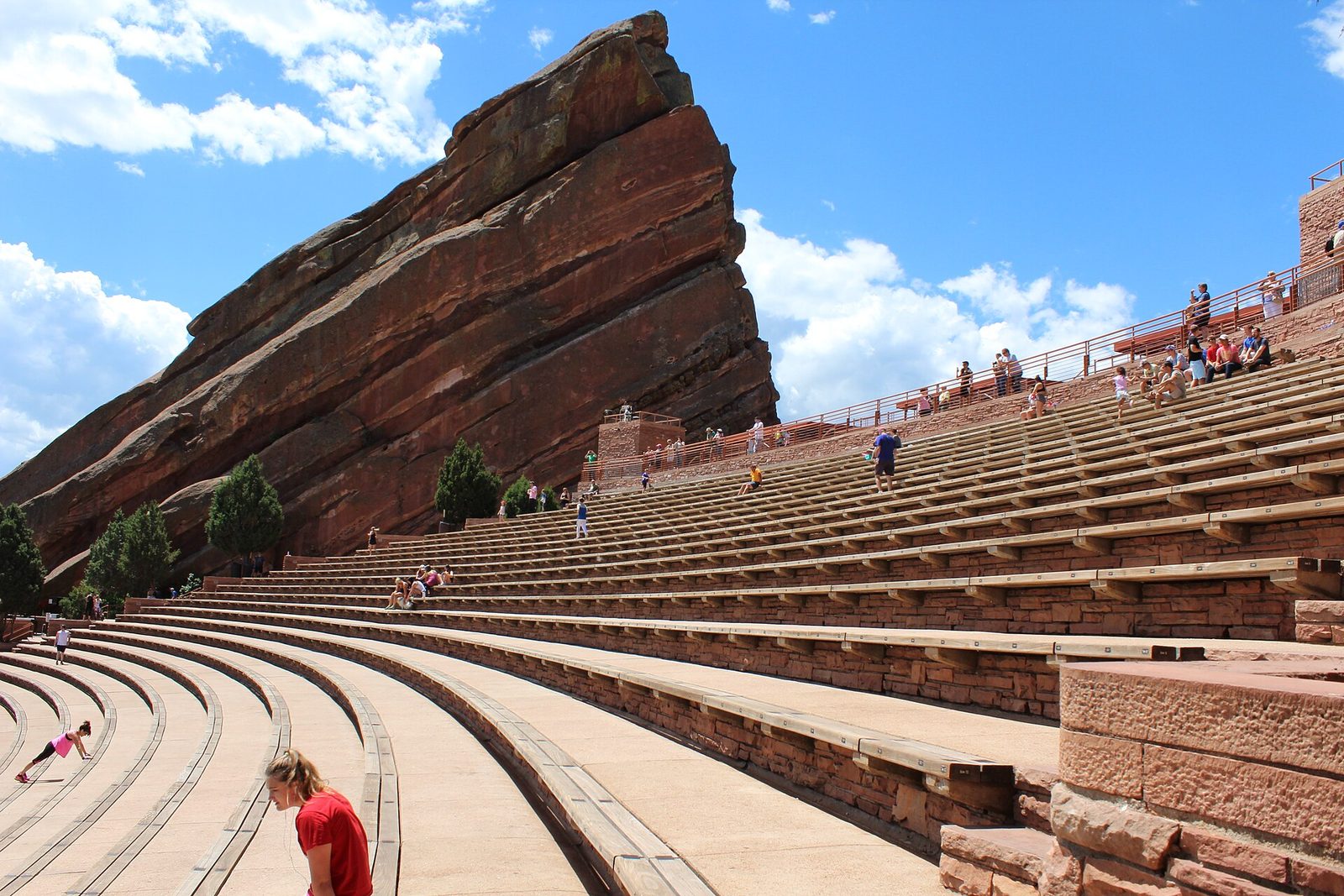
The rocks are roughly 290 million years old, laid down as sand and silt at the foot of the Ancestral Rockies — a mountain range that rose and eroded away entirely long before the current Rockies existed. The formation is called the Fountain Formation, and it is the same red sandstone that produces the Flatirons above Boulder and the Garden of the Gods near Colorado Springs.
The dramatic tilt came much later. When the modern Rocky Mountains were pushed up, starting around 70 million years ago, they levered these sedimentary layers from horizontal to nearly vertical along the entire Front Range. What you are sitting between at a concert are two 300-foot slabs of upended seabed.
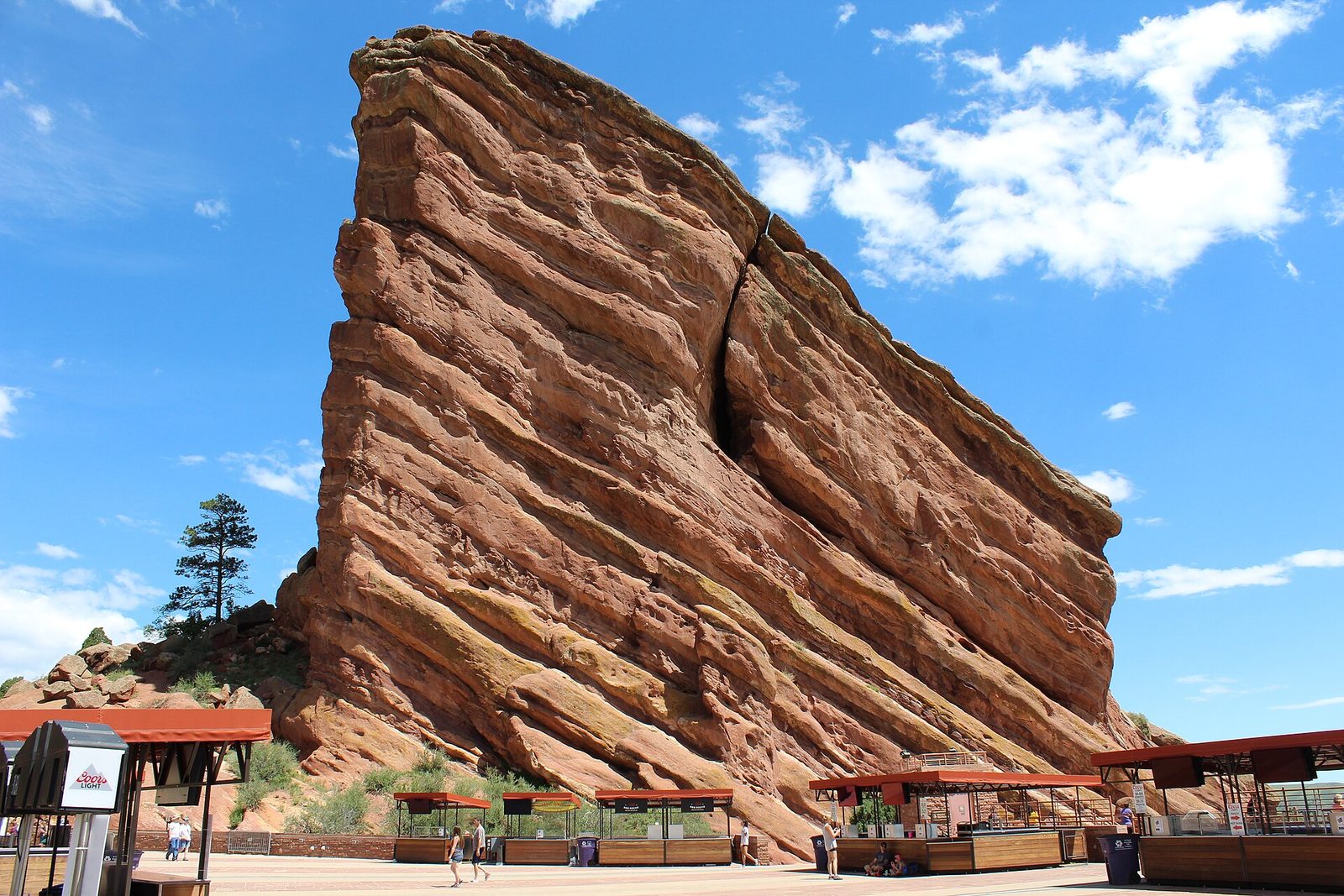
They have names. Creation Rock is the monolith on the north side, Ship Rock the one on the south, and Stage Rock the smaller formation behind the stage. The acoustics everyone raves about are a by-product: two hard parallel reflectors and an open end, which is why a venue built in the 1930s still outperforms engineered ones.
If the geology interests you at all, Dinosaur Ridge is two miles away on the Alameda Parkway hogback, where a road cut exposes dinosaur tracks and bones in situ. It is one of the more remarkable roadside fossil sites in the country and takes an hour.
How the Amphitheatre Was Built
People had been staging concerts in the natural bowl since the early 1900s, on a temporary platform, marketed by a Denver entrepreneur who understood what he had. The city bought the land in 1928 as part of its Mountain Parks system, and the amphitheatre as it exists was designed by the Denver architect Burnham Hoyt and built by the Civilian Conservation Corps — New Deal labor, young men living in a camp on site — between 1936 and 1941. It opened in June 1941.
Hoyt’s instruction to himself was to interfere with the rocks as little as possible. The result is a venue that looks less designed than uncovered, which is exactly the effect, and which is why it holds up ninety years later when almost every other 1930s entertainment venue in America looks its age.
The performance history is the other half of the legend. The Beatles played here in August 1964, on a tour where this was the one show that did not sell out. U2 filmed Under a Blood Red Sky here in June 1983, in rain heavy enough that the band nearly cancelled — the footage made the venue internationally famous and is still the reason a certain generation of European visitor comes. An Easter sunrise service has run for decades. Since 2003 the venue has inducted performers into its own Red Rocks Hall of Fame, and Red Rocks itself was the first inductee into the Colorado Music Hall of Fame.
The Stairs, and Red Rocks as a Gym
The amphitheatre’s second life is as the most scenic outdoor gym in America. On any given morning the seating is full of people running rows, doing step-ups on the benches, hauling weights up the aisles and stretching on the stage apron. It is entirely normal, entirely free, and visitors are welcome to join in.
Two warnings. First, this is 6,400 feet — over 1,100 feet above Denver, which is already a mile high. A fitness level that is comfortable at sea level will not feel comfortable here, and the standard visitor guidance applies: scale it back, drink twice your usual water, and give yourself a day or two in Denver before attempting anything strenuous. Second, the steps are uneven stone in places and the benches are wet with dew until mid-morning.
Yoga on the Rocks runs on summer mornings and sells out quickly — a few thousand people on mats in the bowl at sunrise, which is either the best or the worst thing you have ever heard, depending on temperament. The venue also runs film screenings with live music beforehand in summer, and a variety of fitness events.
Trails in Red Rocks Park
The park is 738 acres and the amphitheatre occupies a small part of it. Three walks are worth your time.
- Trading Post Trail — a 1.4-mile loop starting at the Trading Post that runs down among the formations and back up. Uneven footing, a few hundred feet of elevation change, and the best close-up view of the rocks. Allow 45 minutes to an hour and do not do it in flip-flops, which you will nonetheless see people doing.
- Geologic Overlook Trail — short and steep from the upper north lot, with an interpretive view over the whole formation. Fifteen minutes, and the best orientation point in the park.
- Red Rocks Trail — a longer route running roughly six miles through the park and connecting to Matthews/Winters Park across the highway. This is a proper hike rather than a stroll, and the connection makes a half-day loop possible.
Dogs are allowed on the park trails on leash but not inside the amphitheatre. Summer afternoons bring thunderstorms that build fast over the Front Range and arrive around 3pm with genuine lightning; open rock is the wrong place to be when they do, so walk in the morning.
The Visitor Center, Trading Post and Ship Rock Grille
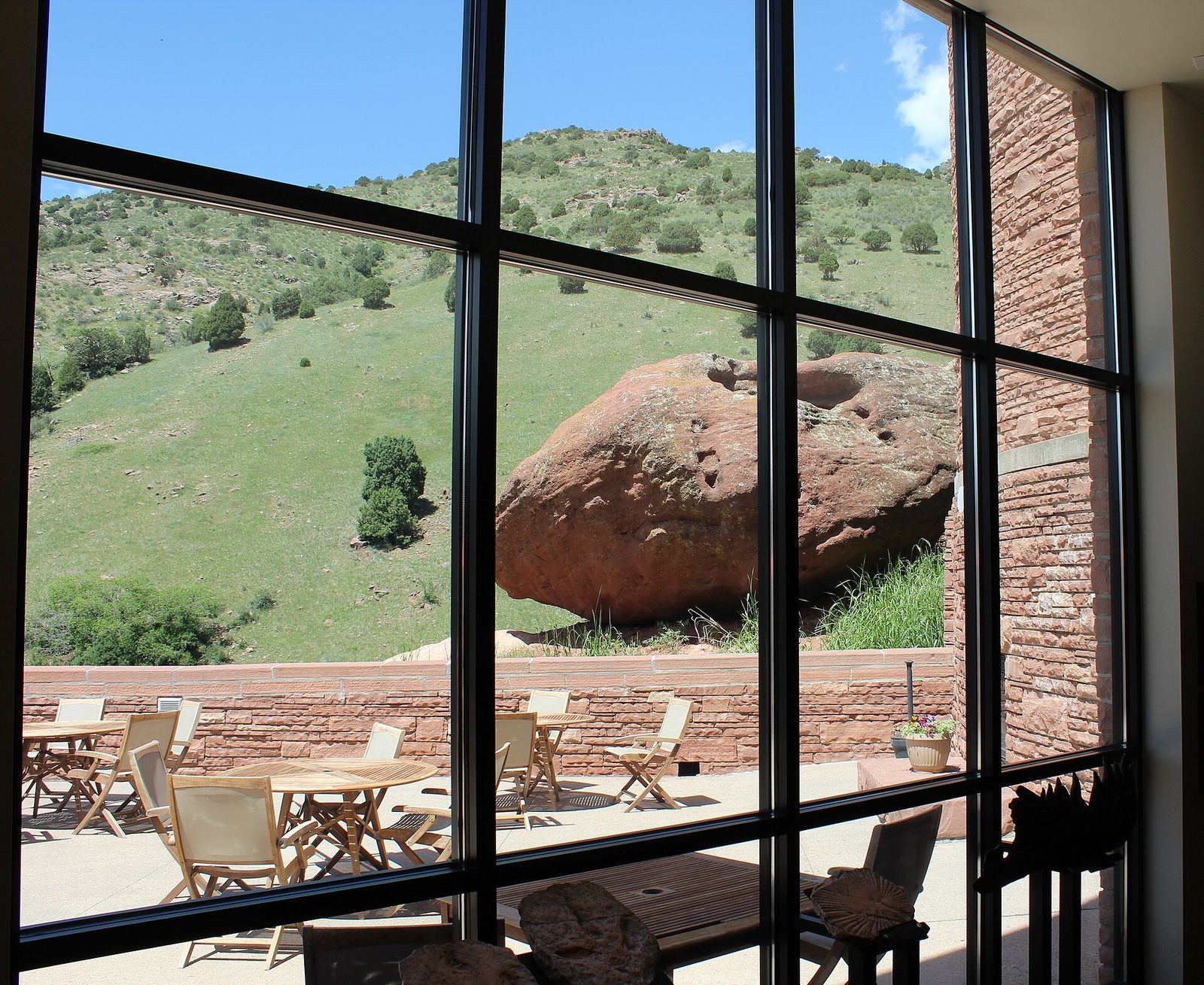
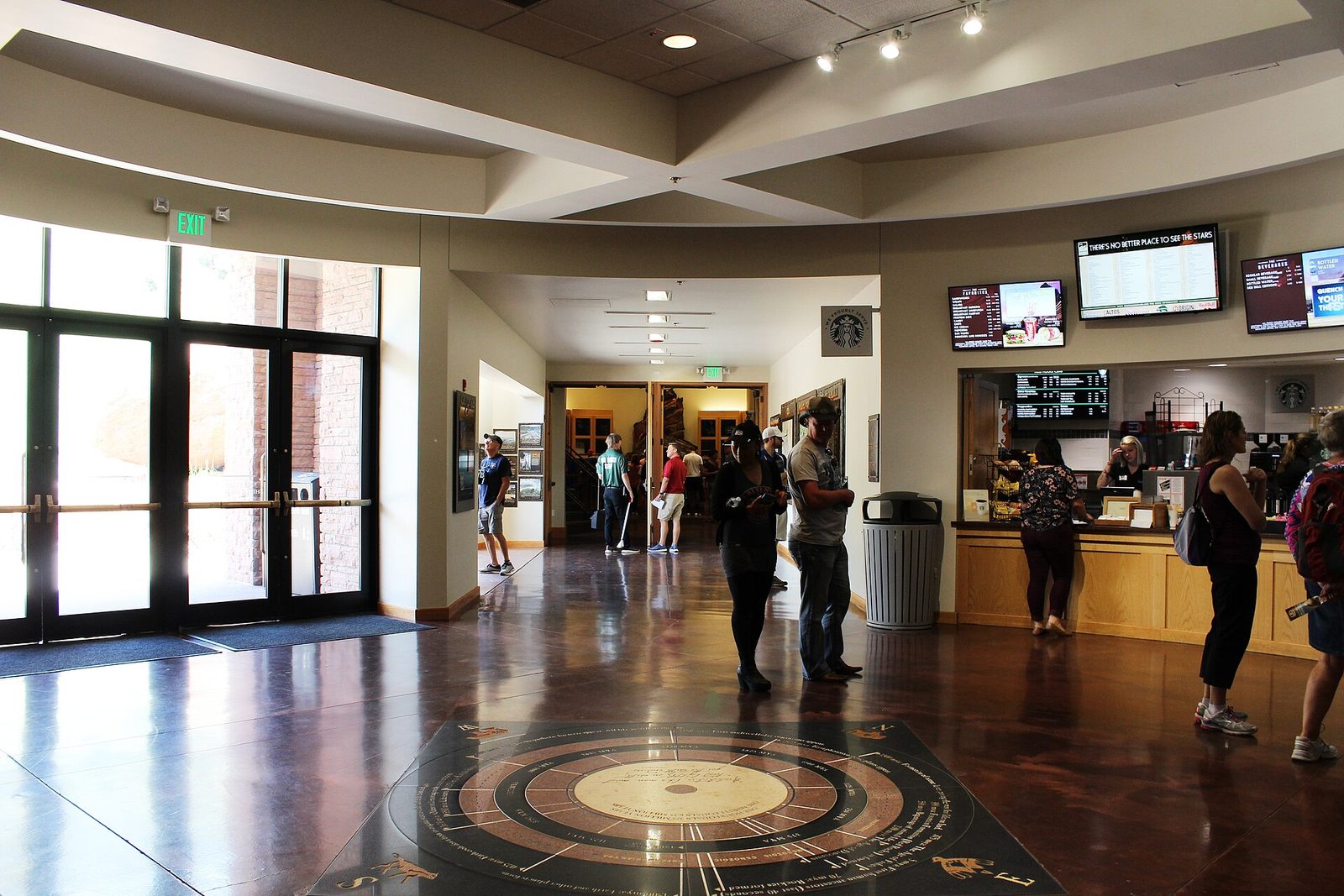
The Visitor Center, which opened in 2003 and is built into the hillside above the top of the seating, holds exhibits on the park’s geology and the venue’s music history, the Red Rocks Hall of Fame, the Heart of the Rock Theatre, restrooms, a gift shop and the Ship Rock Grille, whose glass wall looks straight out at the rocks. Hours are 7am to 7pm from March to October and 8am to 4pm from November to February. It is free.
The Trading Post sits lower in the park, a 1931 pueblo-revival building that predates the amphitheatre, selling souvenirs and housing the trailhead for the loop that shares its name. Free to enter, and the parking there is usually the easiest in the park on a busy weekend.
Going to a Show
A concert at Red Rocks is genuinely one of the great experiences in live music, and it is also a logistical event that people routinely underestimate. The venue’s own guidance and a bit of local practice will save you most of the pain.
Arriving
Parking lots open two hours before doors, and arriving at that moment rather than an hour later is the difference between the upper lots and the overflow. Traffic control directs you to a space; you do not get to choose. Late arrivals are sent to the Jurassic Lot, a mile from the South Gate — walkable, but a mile uphill at 6,400 feet in the dark on the way back. Free shuttles run from the outer lots to the gates during ingress.
What you can bring
Bags must fit under your seat — the stated limit is 18 by 12 inches — and they are opened and inspected at the gate. Bring layers regardless of the forecast: a July evening at this elevation can drop 25 degrees after sunset, and there is no shelter in the bowl. A rain jacket is not optional in summer. Sunscreen matters even for an evening show if you arrive while the sun is still on the rocks.
Seats
Every seat is a bench, numbered by row to about 70, and none has a back. General admission shows mean a queue up the hill for the rows nearest the stage; reserved shows mean you can arrive at doors and still sit where your ticket says. Rows in the 40s and 50s are the sweet spot for most people — full view of the stage, the rocks on both sides and the Denver skyline behind you when you turn around.
Leaving
The exodus is the part nobody warns you about. Ten thousand people leave a canyon with limited road capacity at the same moment, and it can take 45 minutes to an hour to get out of the park. After the show only a limited shuttle runs, from the Top Circle Lot and the Trading Post down to the Jurassic Lot. Two strategies work: leave during the last song, or do the opposite and sit on a bench for half an hour while the lots drain. Fighting it in the middle is the worst of both.
The Rest of the Calendar
Concerts are what Red Rocks is known for, but the venue programs itself far more broadly than that, and several of the alternatives are easier to get into and cheaper than a headline show.
Yoga on the Rocks puts several thousand people on mats in the bowl on summer mornings. Tickets are inexpensive and they sell out fast, usually well before the date. It is an odd, genuinely memorable thing: sunrise over the plains, a few thousand strangers, and an instructor amplified through a sound system built for stadium rock.
Film on the Rocks screens a movie on a large outdoor screen with live music beforehand, on summer evenings. The films are populist and the point is not the film — it is watching something silly with 8,000 people between two 300-foot rocks. It is the cheapest way to experience a full house here.
The Easter sunrise service has run for decades and draws a large crowd in the cold dark before dawn; it is free and open to anyone. Local high schools and universities hold graduations in the bowl in May, which close the amphitheatre to casual visitors on those mornings — another reason to check the calendar. And the venue hosts a steady stream of fitness events, races and community days through the warm months.
Outside all of it, the default state of Red Rocks for most of the year is empty and open, which remains the best-value thing on this page.
Eating Near Red Rocks
Options are limited inside the park and better just outside it, which shapes how you plan the visit.
The Ship Rock Grille in the Visitor Center is the only sit-down option in the park, with a glass wall facing the rocks and a patio. It keeps daytime hours in line with the Visitor Center and is a reasonable lunch rather than a destination. On concert nights the park’s concession stands operate on the upper plaza, priced as venue concessions everywhere are.
Morrison, immediately south of the park, is where locals actually eat. It is two streets of restaurants, patios and a bakery, busy on weekends with motorcycle traffic heading into the foothills, and it will take a walk-in party far more readily than anywhere in Denver will on a Saturday. Ten minutes north, Golden has a proper main street with more range.
Tailgating in the lots before shows is part of the culture here, but what is permitted changes with the event and the venue has tightened rules over the years — check the specific show’s page rather than assuming. Glass is generally not welcome anywhere in the park, and nothing you bring will get past the bag inspection at the gate.
Taking the Photograph
Nearly everyone wants the same frame: the rows of benches sweeping down to the stage, a rock slab on each side, Denver on the horizon. Getting it well is mostly about timing.
Shoot from the top of the seating, standing at the back near the Visitor Center, in the first hour after sunrise. The light comes from the east directly into the bowl, the sandstone goes genuinely red rather than brown, the skyline is sharp before the day’s haze builds, and there is nobody in your frame except a few people running the steps. Late afternoon light is flatter and hits the rocks from behind.
For the rocks themselves rather than the venue, drop down to the Trading Post Trail, where the formations tower over you and there is no seating in the shot. For the classic wide view of the whole hogback, the Geologic Overlook is fifteen minutes uphill from the north lot.
One thing to accept: during a concert, phone footage of the stage from row 50 looks like everyone else’s phone footage of a stage. Turn around instead and photograph the crowd with the plains and the city lights behind them. That is the shot that only exists here.
Red Rocks with Children
The park works well with children on a free morning and works less well at a concert. On a non-event day, the bowl is effectively an enormous staircase, the trails are short, the Visitor Center exhibits hold attention for half an hour and nothing costs anything — which makes it one of the better family mornings in the Denver area.
The caveats are physical. The steps are uneven, the drop-offs at the edges of the upper seating are real, there is little shade anywhere, and the altitude affects small children as much as adults. Bring more water than seems necessary, put hats on everyone, and plan for the walk back up from the Trading Post to be slower than the walk down.
At a show, the practical limits are the late finish, the volume and the mile-long walk from overflow parking in the dark. Film on the Rocks is the family-friendly exception, and the Easter sunrise service is another.
What Red Rocks Gets Wrong
- The show-day sunset trap. More visitors are disappointed by this than by anything else in the Denver area — driving out for golden hour on a day when a concert closes the amphitheatre from mid-afternoon. One look at the calendar prevents it.
- The assumption that you need a ticket. Plenty of people put Red Rocks on the list, see $95 plus fees for a band they half-like, and cross it off. The park is free. Go in the morning.
- Underestimating the walk. From the lower lots to the top of the amphitheatre is a genuine climb. Visitors with mobility limitations should know that accessible parking exists at the top and that accessible seating is at row 1 and row 70 with staff assistance — plan around that rather than discovering it in the dark.
- Treating it as a quick stop. An hour is enough to see the bowl. Two and a half gets you the loop trail, the Visitor Center and a proper sit in row 40, which is the actual experience.
- Summer afternoons. Hot, exposed, crowded and prone to storms. Early morning is better in every measurable way, and it is also when the light on the rocks is best.
When to Go
Spring and fall mornings are the best of it: cool, clear, quiet, with the rock color at its deepest in low light. Summer works before about 10am and is unpleasant after that. Winter is genuinely underrated — the park stays open, snow on red sandstone is a striking combination, the concert calendar is mostly dark so access is unrestricted, and you may have the place close to yourself. Check conditions before driving up after a storm, because the park roads are steep and the gates do close.
For concerts, the season runs roughly April to October, peaking in summer. For everything else, any clear morning will do. Our Denver itinerary guide sets out which day of a two, three or five-day trip Red Rocks belongs on, and our things to do in Denver guide ranks it against everything else competing for that morning.
Frequently Asked Questions
Is Red Rocks free to visit?
Yes. On non-event days, admission and parking are both free, and that covers the park, the amphitheatre itself, the Visitor Center and the Trading Post. The park is open from an hour before sunrise to an hour after sunset. On show days, the amphitheatre closes to non-ticket-holders from mid-afternoon.
How do I get to Red Rocks from Denver without a car?
With difficulty. There is no scheduled RTD service to the park. The realistic options are a rideshare with a plan for the return trip, a commercial concert shuttle from a downtown hotel on show nights, or a rental car for the day. Rideshare availability drops sharply at dusk and immediately after concerts, which is exactly when you will want it.
How long should I spend at Red Rocks?
An hour to see the amphitheatre, two and a half to do it properly — the bowl, the Trading Post Trail loop and the Visitor Center. A concert is an evening in its own right, from arrival two hours before doors to getting out of the parking lot afterwards.
How high is Red Rocks and will the altitude affect me?
The amphitheatre sits at roughly 6,400 feet, more than 1,100 feet above Denver’s 5,280. Climbing the steps will feel harder than the same climb at home. Drink about twice your usual water, take the stairs slowly on your first day in Colorado, and treat any strenuous workout here as something for later in your trip.
What should I bring to a concert at Red Rocks?
Layers, a rain jacket, sunscreen and a bag small enough to fit under your seat — the stated limit is 18 by 12 inches, and bags are inspected at the gate. A cushion is welcome, since every seat is a backless stone bench. Cash or card for concessions, and shoes you can walk a mile uphill in if you end up in the overflow lot.
Can you go inside the amphitheatre when there is no show?
Yes, and you should. Walk in, sit anywhere, run the steps, take the photograph from the top with the Denver skyline on the horizon. The stage is usually accessible when there is no production loading in. This is the version of Red Rocks that locals actually use.
Can you see the Denver skyline from Red Rocks?
Yes, and it is the view that surprises people most. From the upper rows the ground falls away east and the downtown skyline sits on the horizon about eleven miles off, with the Great Plains running flat behind it. It is clearest in the morning before the day’s haze builds, and at night during a show it becomes a field of city lights behind the crowd — which is the photograph worth taking rather than another picture of the stage.
Is Red Rocks worth visiting if I am not going to a concert?
It is arguably better without one. A morning visit costs nothing, takes two hours including the Trading Post Trail loop and the Visitor Center, has no crowds, no parking exodus and no $95 ticket, and gives you the geology, the acoustics demonstration of standing on the stage and talking, and the view east. The concert is a superb night out; the park is the thing that belongs on every Denver itinerary regardless.
What else is near Red Rocks?
Morrison, at the south gate, for lunch. Dinosaur Ridge, two miles away, for fossil tracks exposed in a road cut. Golden, ten minutes north, for Clear Creek and a genuine small-town main street. Any of the three turns a Red Rocks morning into a full day west of the city.
Because there is no scheduled transit to the park, Red Rocks is usually the day that decides whether a Denver trip needs a rental car at all — and that, in turn, decides which neighborhood is the right one to book. Our where to stay in Denver guide sets out the areas that work without a car and the ones that only make sense with one.
Red Rocks is the shortest of the trips west, and it pairs naturally with the rest of the foothills — Golden is ten minutes north, Morrison sits at the south gate, and the Lariat Loop over Lookout Mountain ties them together in half a day. Our day trips from Denver guide sets out that circuit and everything further up I-70.
The Trading Post loop is the shortest of a whole network of trails that begins where the city stops, and several of the best of them are within half an hour of the amphitheatre — Matthews/Winters directly across the interstate, Mount Falcon on the ridge above Morrison, Roxborough forty minutes south. Our guide to the best hikes near Denver covers them all, with fees, seasons and honest altitude advice.
Concert season at Red Rocks runs roughly April to October, and the edges of it are colder than people expect at 6,400 feet. June and September are the comfortable months for a show that finishes at ten; the free daytime visit works in any month the road is clear. Our guide to the best time to visit Denver sets out the seasonal picture, including when afternoon storms are close to a daily event.
Red Rocks is the biggest name on Denver’s live calendar but far from the only one. The Stock Show fills sixteen January days, PrideFest draws more than half a million people in June, and the Great American Beer Festival moved outdoors to Levitt Pavilion in 2026. Our guide to Denver events sets out the whole year, including which venues are awkward to reach without a car.
Red Rocks is the biggest room in the region but far from the only one, and a concert here is an expedition rather than a night out in the city. The Fillmore, the Ogden and the Bluebird sit within a few blocks of each other on Colfax, and between them they carry most of Denver’s live music all year. Our guide to Denver nightlife covers those venues, the 2am last call and the transport that decides how the evening ends.
Related Denver Guides
- Denver Itinerary: How to Plan One to Five Days in the City — where the Red Rocks morning fits, and when to rent the car.
- Things to Do in Denver: The Complete Attractions Guide — how Red Rocks ranks against the rest of the city’s attractions.
- Downtown Denver: A District-by-District Guide to the City Core — the other half of a first Denver visit.
Photo Credits
Red Rocks Amphitheatre from the upper rows: photo by Sarbjit Bahga / Wikimedia Commons (CC BY-SA 4.0)
Creation Rock and the seating bowl: photo by Sarbjit Bahga / Wikimedia Commons (CC BY-SA 4.0)
Ship Rock above the upper plaza: photo by Sarbjit Bahga / Wikimedia Commons (CC BY-SA 4.0)
Ship Rock Grille in the Visitor Center: photo by Sarbjit Bahga / Wikimedia Commons (CC BY-SA 4.0)
Hours, access rules and show-night logistics were checked against the venue’s own site in September 2026. Event schedules, gate times and policies change; confirm on the official Red Rocks calendar before you travel.
Denver Tourism Guide is an independent publication. We are not affiliated with VISIT DENVER, the City and County of Denver or any attraction listed here.