Stand at 17th and Wynkoop with your back to Union Station and the whole logic of the city is in front of you: a 19th-century warehouse district running downhill to the South Platte, a 1980s office core standing on top of it, and the Front Range closing the view west. Downtown Denver is unusually compact for an American city of its size — about a mile and a quarter from the station to the Capitol, most of it flat, nearly all of it walkable — and it is also strange, because the streets you are standing on are rotated 45 degrees from every other street in Denver. This guide covers what is down here, how the pieces connect, and which famous stops are worth less than their reputation. Prices checked September 2026.
Downtown is not one place. It is six adjacent districts with different personalities and different opening hours, and knowing which is which saves you the classic visitor mistake of walking twenty minutes in the wrong direction to reach a restaurant that turns out to be four blocks from where you started. What follows is the map in the order most people actually use it: the station, the old warehouse blocks, the rebuilt 16th Street spine, the ballpark end, the civic end, and the theater district in between.
The Districts of Downtown at a Glance
| District | What it is | Best time | Worth how long |
|---|---|---|---|
| Union Station & Central Platte Valley | The transit hub, the Great Hall, Riverfront Park, Confluence Park | Morning, or late evening for the bar | 1–2 hours, plus every arrival and departure |
| Lower Downtown (LoDo) | Victorian warehouse blocks, Larimer Square, the Dairy Block, most of the good bars | Late afternoon into evening | 2–3 hours |
| 16th Street | The 1.25-mile pedestrian spine with the free shuttle | Any time; it is the connective tissue | Pass through, do not linger |
| Ballpark | Coors Field and the blocks north of 20th | Game days, April to September | 3 hours with a game, 90 minutes with a tour |
| Theatre District | Denver Performing Arts Complex, ten venues on four blocks | Evening | An evening |
| Civic Center & Golden Triangle | The Capitol, Denver Art Museum, Clyfford Still, History Colorado | Weekday mornings | Half a day, easily |
Why the Streets Point the Wrong Way
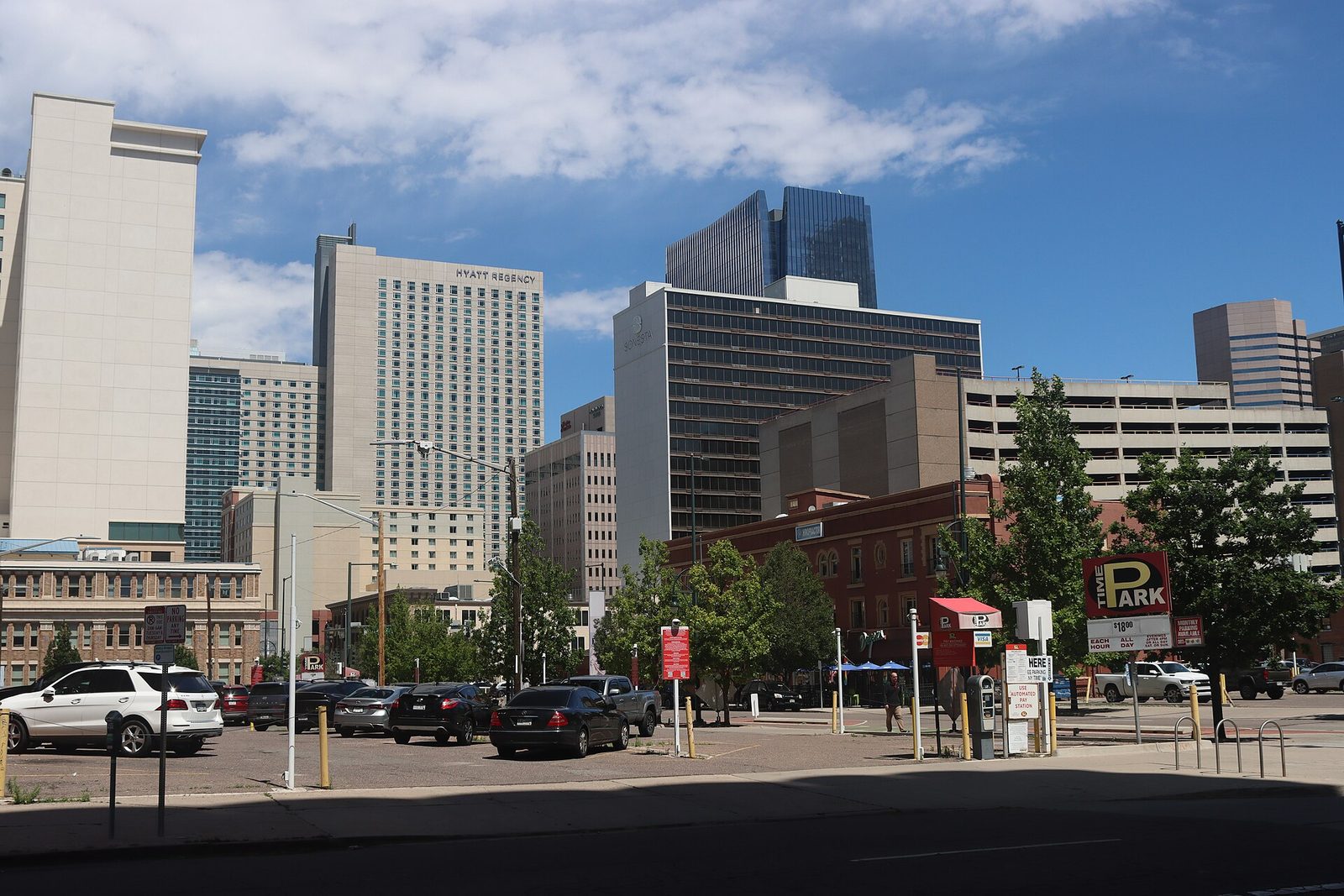
The original 1858 townsite was laid out parallel to the South Platte River and Cherry Creek, which run northeast to southwest here. Everything platted later followed the compass instead. The seam runs roughly along Broadway and Colfax, and the result is that Larimer, Market, Blake, Wazee and Wynkoop sit at a diagonal to the numbered avenues that govern the rest of the city.
Two practical consequences. First, “north” downtown is not north; when a local says the ballpark is at the north end of downtown, they mean northeast. Second, the numbered streets downtown (15th, 16th, 17th) are not the numbered avenues elsewhere (17th Avenue is a completely different road, two miles long and nowhere near 17th Street). Visitors lose real time to this. The fix is to navigate by the named cross streets — Wynkoop, Wazee, Blake, Market, Larimer, Lawrence, Arapahoe, Curtis, Champa, Stout, California, Welton — which run in alphabetical-ish order as you move away from the river, and to remember that the mountains are west.
The other orientation rule: downtown slopes. Union Station sits low near the river and the Capitol sits on a rise. Walking from the station to the gold dome is a gentle, constant climb of about 100 feet, which at 5,280 feet you will notice on your first day and not on your third.
Union Station and the Central Platte Valley
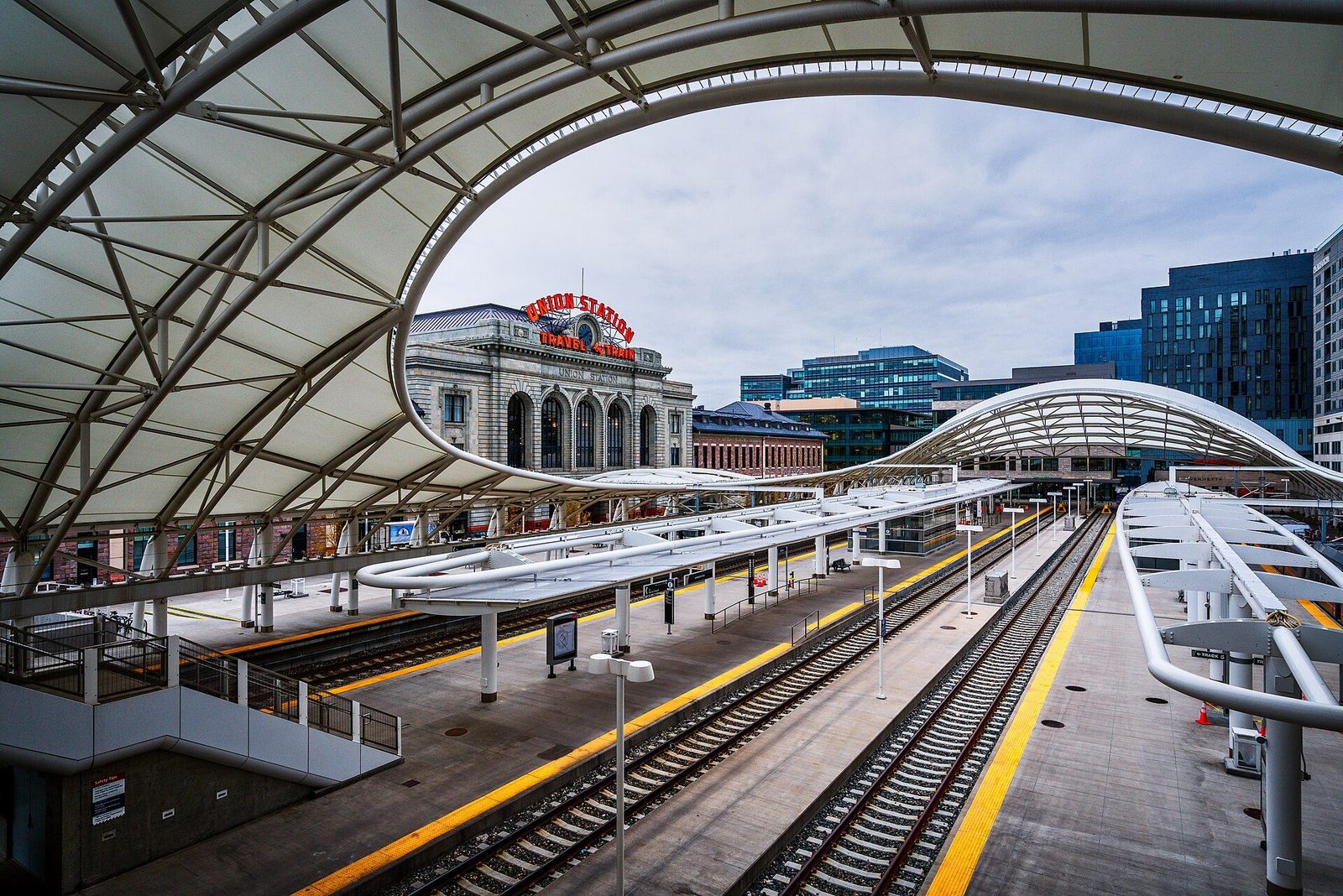
Union Station is the best building in the city and the most useful. The 1914 beaux-arts station was restored and reopened in 2014 with a train hall attached, and the Great Hall is free and open to the public — you can sit in it, work in it, meet someone in it, and nobody will ask whether you have a ticket. Long communal tables, leather chairs, a bar at one end, restaurants around the edges. On a cold morning it is the best free room in Denver.
Functionally it is the hinge of any visit. The A Line reaches Denver International in about 37 minutes. The 16th Street FreeRide starts here. The Flatiron Flyer runs to Downtown Boulder Station in roughly 55 minutes. Light rail, Amtrak’s California Zephyr and the regional bus concourse all meet underneath.
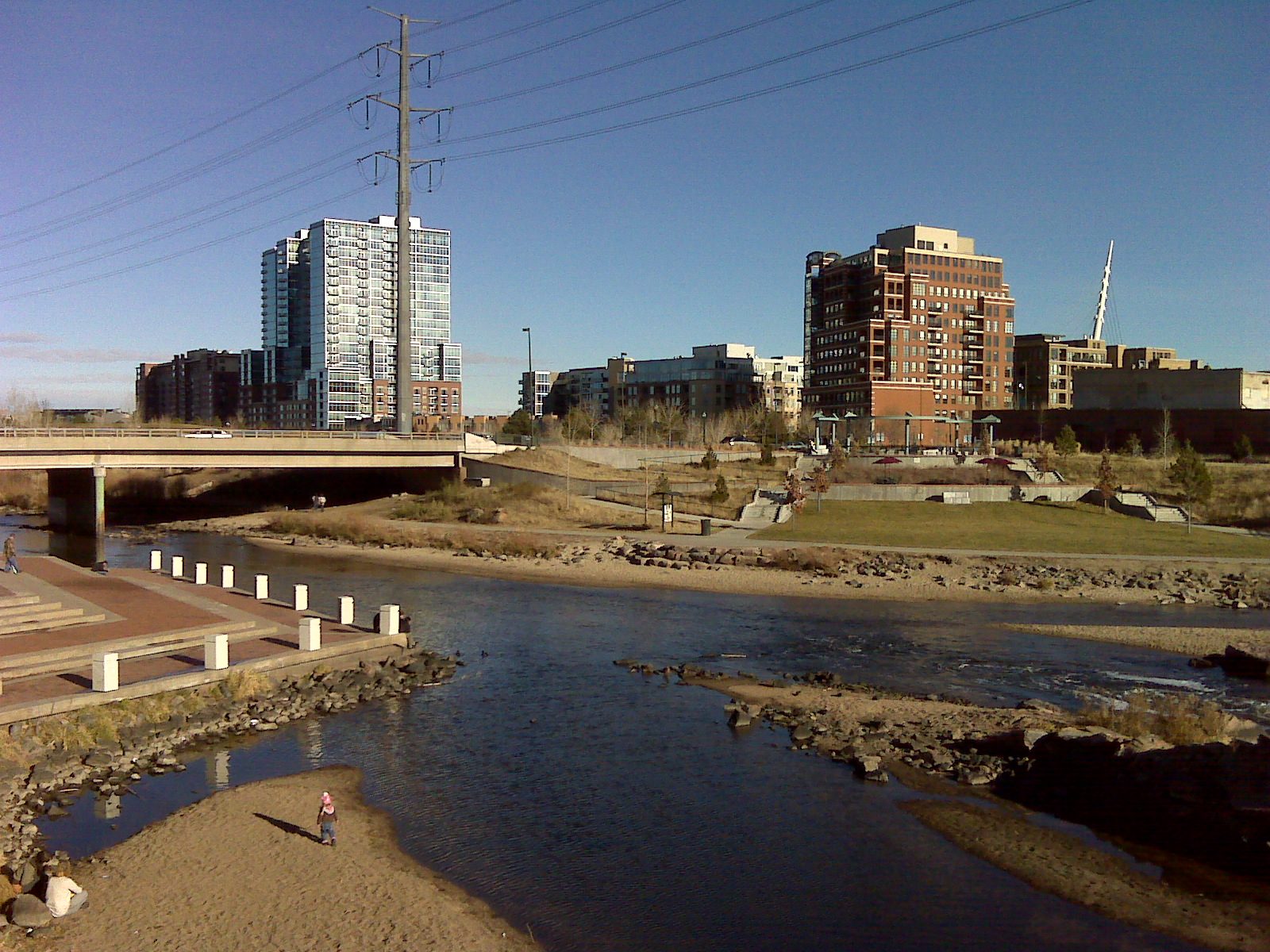
Walk west from the station over the Millennium Bridge and you are in Riverfront Park, a dense residential district built on old rail yards in the 2000s, with a lawn that fills on summer evenings. Continue to Confluence Park, where Cherry Creek meets the South Platte and where Denver was founded in 1858 by prospectors who found barely any gold. There is a small whitewater park, a beach of sorts, and an unglamorous, genuinely pleasant scene of people tubing, cycling and drinking coffee that tells you more about how the city lives than any attraction does.
Lower Downtown: The Blocks That Nearly Went
LoDo is the twenty-odd square blocks between Union Station and 20th Street, and it exists because a demolition program stopped short. Denver spent the 1960s and 70s clearing Victorian commercial buildings under urban renewal — Skyline Park’s superblocks are the scar — and the warehouse district survived mostly because nobody wanted it yet. It became a historic district in 1988, the ballpark landed in 1995, and the brick survived to become the most valuable real estate in the region.
What that means for a visitor is an unusually intact stretch of 1880s commercial architecture in a city otherwise known for glass. Walk Wazee and Blake between 15th and 20th and look up: iron cornices, painted ghost signs, loading bays converted into restaurant frontage.
Larimer Square
The 1400 block of Larimer is the oldest commercial street in Denver and the first block anyone thought to save — it became the city’s first historic district in 1971, largely through the efforts of Dana Crawford, whose name is now on the hotel inside Union Station. Today it is a single pedestrianized block with string lights overhead, Colorado flags strung between the buildings, restaurant patios down both sides and a handful of independent shops. It is small. People arrive expecting a district and find a block, and the honest framing is that it is one very good block, best at dusk, best with a reservation.
The Dairy Block and McGregor Square
Two recent developments fill the gap between LoDo and the ballpark. The Dairy Block, on Wazee between 18th and 19th, is a converted dairy plant wrapped around a narrow alley of bars and small shops — self-consciously designed, genuinely fun after dark. McGregor Square, opposite Coors Field, is a modern plaza with a giant screen that shows Rockies games, surrounded by restaurants and a hotel. Neither is historic. Both work, which is not something you can say about most new downtown plazas.
16th Street After the Rebuild
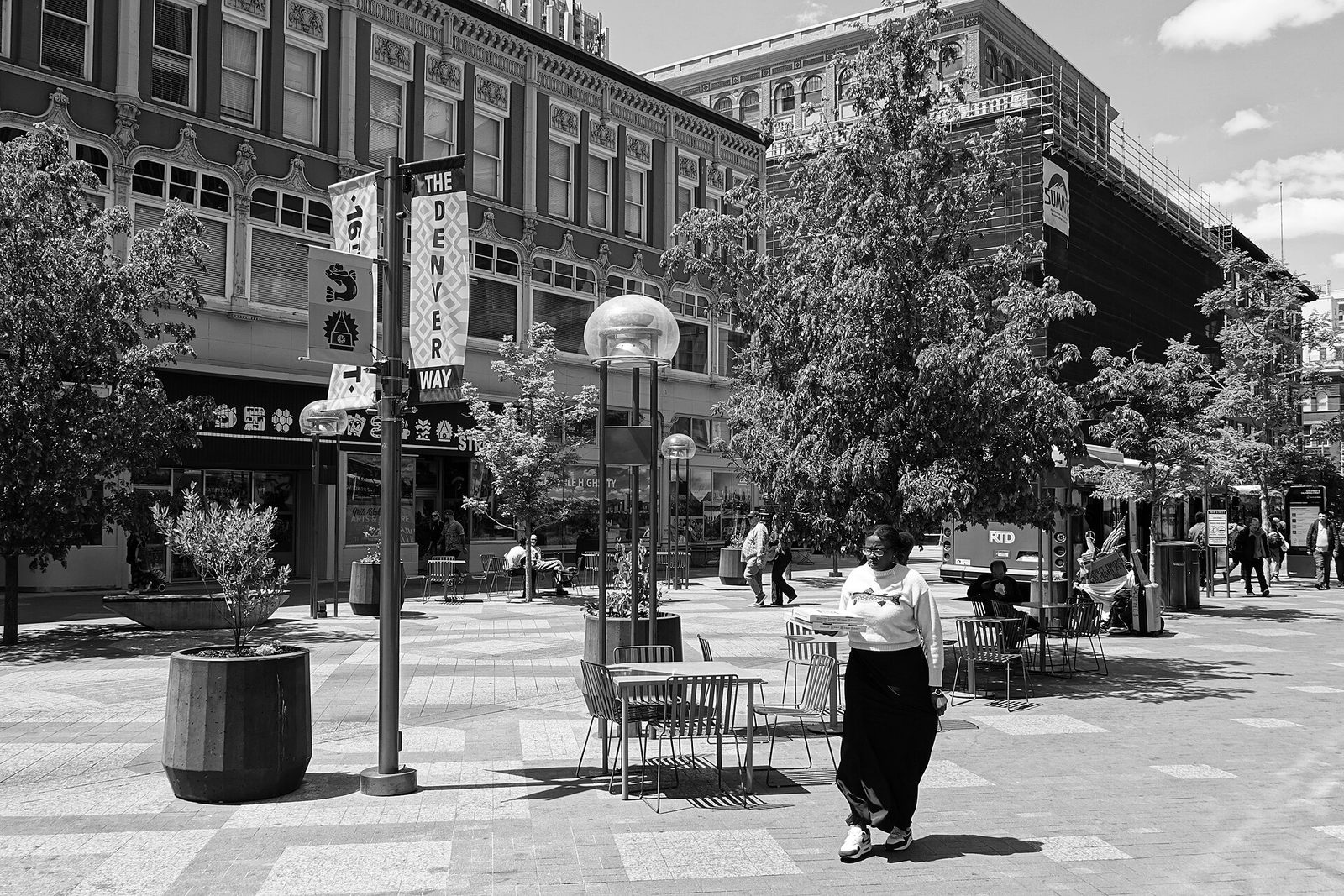
The 1.25-mile pedestrian spine running from Union Station to Civic Center closed for a $175.4 million reconstruction and fully reopened in October 2025. Anything you read describing 16th Street as a construction zone, or as the Free MallRide, is out of date: the shuttle came back as the 16th Street FreeRide, free, seven days a week, at roughly five-minute intervals.
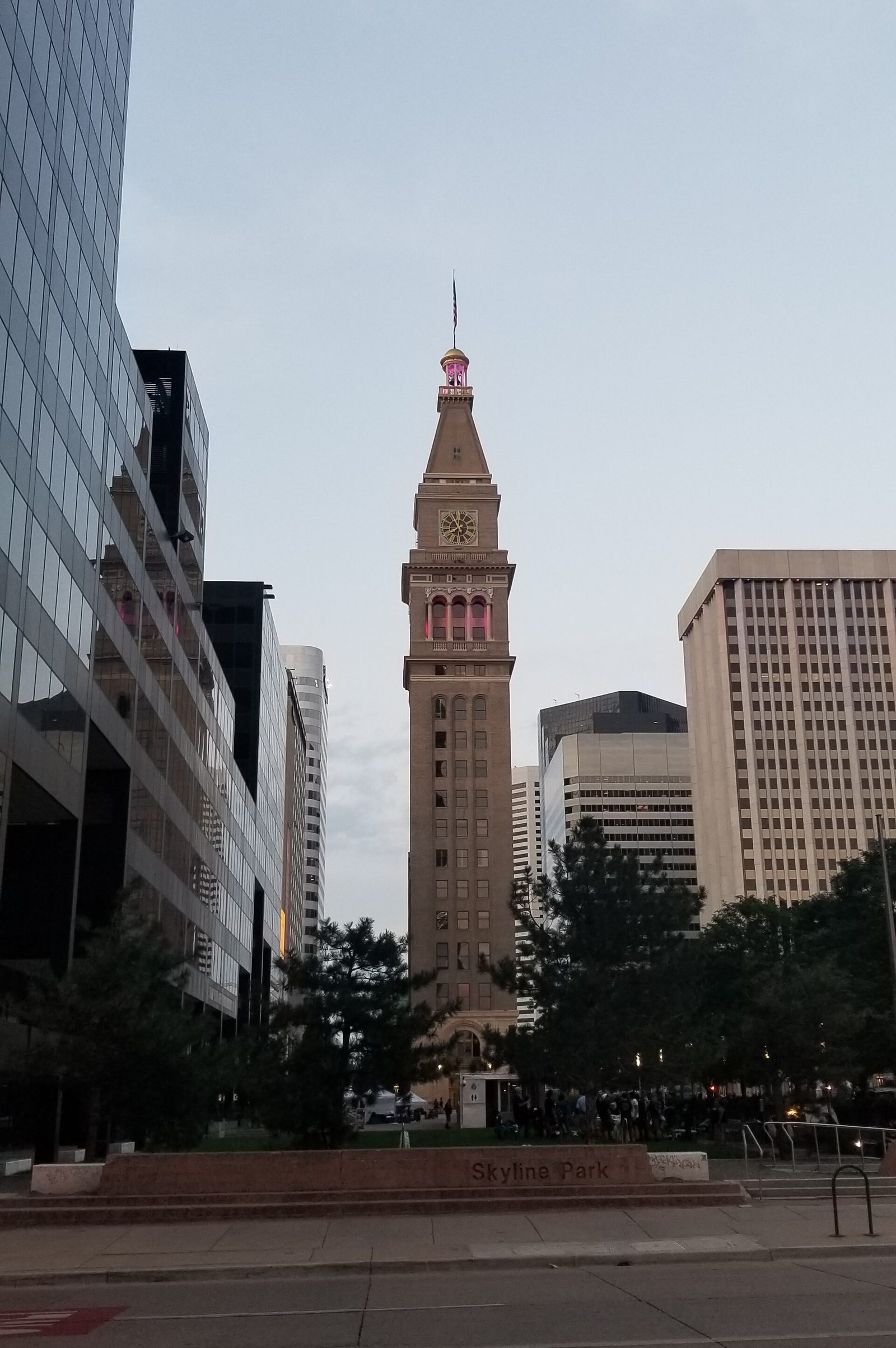
The rebuild widened sidewalks, replaced the granite, added trees and moved the shuttle lane. What it did not do is change the fundamental character of the middle third, which is chain stores, phone shops and fast food. The honest advice: 16th Street is excellent transport and mediocre sightseeing. Ride it, get off at the ends, and do not plan an afternoon on it. The good stretches are the first three blocks from Union Station and the last three near Civic Center, plus Skyline Park, where the 1910 Daniels & Fisher Tower — 325 feet, modeled on the campanile in Venice, and the tallest building between the Mississippi and California when it opened — still stands with its clock faces lit.
The Ballpark District and Coors Field
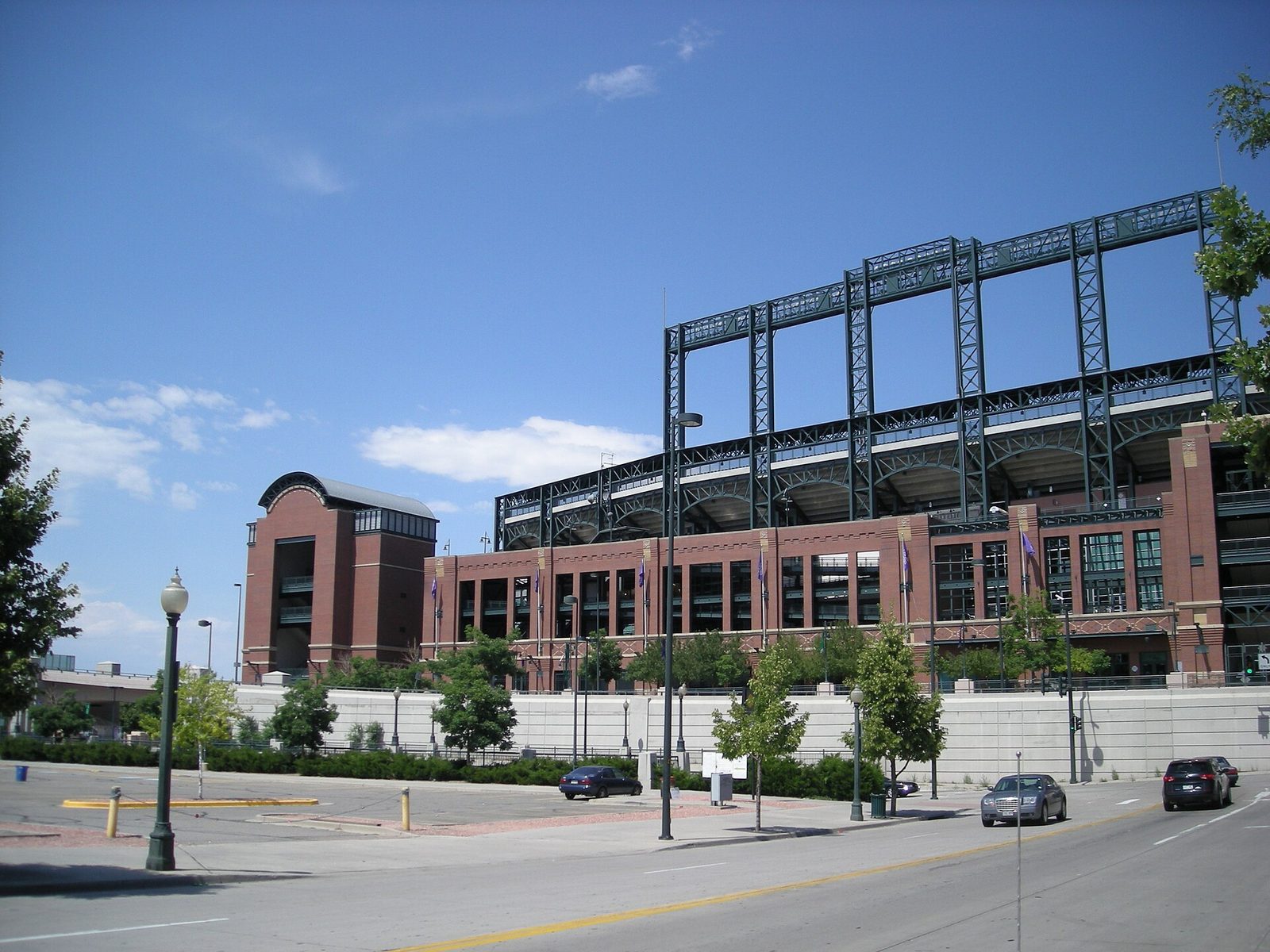
Coors Field opened in 1995 at 20th and Blake, and unlike most ballparks of its generation it was dropped into an existing street grid rather than a parking sea — which is why the blocks around it have bars rather than asphalt. The stadium is red brick with green steel, and the detail worth knowing is the purple row in the upper deck, which marks exactly one mile above sea level.
You do not need a game to go in. Public tours run Monday to Saturday, $10 for adults, $8 for seniors 55 and over and $7 for children 12 and under, take 70 to 80 minutes, cover about a mile on foot and start at Gate D on the corner of 20th and Blake. Times vary on game days. It is one of the better-value hours downtown.
If there is a game, go. Rockies tickets are routinely the cheapest ticket in Major League Baseball, the upper deck has a full view of the Front Range, and the ball genuinely does carry differently at altitude — which is why the humidor in the basement is a real piece of baseball engineering rather than a curiosity. Bring a layer: a July evening at 5,280 feet drops fast after sunset.
Sport Beyond Baseball
Downtown is one of very few American city centers where three major-league venues sit within walking distance of each other and of the hotels.
Ball Arena, at the western edge past the Auraria campus, is home to the Nuggets and the Avalanche and takes a ten-minute walk or one light-rail stop from Union Station. Empower Field at Mile High, where the Broncos play, is just across I-25 and served by its own rail station — close enough that a Sunday home game visibly changes downtown’s mood and parking prices all day. Note that Meow Wolf, near the stadium end of the valley, suspends its $15 parking during Broncos home games, which catches people out.
The newer fixture is Denver Summit FC, which plays its inaugural NWSL season in 2026. The club sold out 8,500 season tickets before a ball was kicked, and the schedule is split across Empower Field, Dick’s Sporting Goods Park in Commerce City and a new stadium in Centennial from 18 July — so always check which venue a given date uses before you build an evening around it. Commerce City and Centennial are not downtown and not a short walk from anything.
If the calendar offers a choice, the Rockies are the cheapest and most relaxed, the Nuggets the hardest ticket, and the Avalanche the loudest room in the city.
The Theatre District
The Denver Performing Arts Complex occupies four blocks and 12 acres between 13th and 14th on Curtis and Champa, and holds ten performance spaces ranging from about 200 seats to the 2,839-seat Buell Theatre, under a glass arch that runs the length of the site. The Denver Center for the Performing Arts produces its own theater here alongside touring Broadway, the opera and the symphony next door at Boettcher.
For a visitor the practical points are these: it is a five-minute walk from the 16th Street shuttle at Arapahoe, it is dark on many Mondays, and the cheap seats in the Buell are genuinely fine because the room is steep. Note the spelling conventions if you are searching for tickets — the complex uses Theatre, the touring house is the Buell Theatre, and the Denver Center’s own venues use their donors’ names.
Civic Center and the Golden Triangle
The southeastern end of downtown is the civic and cultural one, and it is the most efficient half day in Denver because four significant buildings sit within three blocks.
- Colorado State Capitol — free tours Monday to Friday on the hour from 10am to 3pm, walk-ins welcome, groups of ten or more need to book. The mile-high marker is on the west steps and the dome climb is 99 steps above the third floor, stairs only. The building is open weekdays 7:30am to 5pm.
- Denver Art Museum — $22 off-peak and $25 peak for Colorado residents, $27 and $30 for non-residents, free for everyone 18 and under, every open day. Closed Wednesdays. Open until 8pm on Tuesdays.
- Clyfford Still Museum — $10, timed entry in 15-minute intervals, reserved in advance and not sold at the door. One artist, one building, roughly ninety minutes.
- History Colorado Center — $20, free for 18 and under, 10am to 5pm daily, and the best single explanation of how this state came to look the way it does.
Between them sits Civic Center Park itself, with its Greek amphitheater and the McNichols Building, plus food-truck gatherings in summer. The park has had a rough decade and an ongoing restoration; it is pleasant by day and not somewhere to linger after dark.
Eating and Drinking Downtown
Downtown covers the full range, and the geography is simple: LoDo and the Dairy Block for bars, Larimer Square and Union Station for sit-down dinners, 16th Street for a sandwich you will forget, and the Ballpark blocks for anything loud.
A few structural things worth knowing. Denver eats early by coastal standards — a 7pm reservation is prime time and 9pm is late. Brewery taprooms are everywhere and most are family-friendly until evening. Union Station’s own restaurants are good but priced for the room. And altitude does change how alcohol lands: the official visitor guidance is to go easy until you are acclimatized, and it is real advice rather than a quirk of local folklore.
Three patterns save money without sacrificing much. Lunch is where downtown’s expensive kitchens become affordable, and several Larimer Square and Union Station rooms run a midday menu at half the dinner price. Happy hour is taken seriously here, generally 3pm to 6pm, and in the Dairy Block and along Blake Street it is a genuine meal rather than a bowl of nuts. And the breweries almost never serve food themselves — they let food trucks park outside or allow you to bring your own, which is why you will see people eating pizza from a box at a taproom table and nobody minding.
What downtown does not have is a great cheap-eats street. There is no Chinatown, no dense taquería strip, no late-night noodle row; for that you go out to Federal Boulevard, which is a twenty-minute drive southwest and worth its own trip. Downtown’s strength is mid-to-high-end dining in restored buildings, and its weakness is the $18 sandwich.
Buildings Worth Looking Up At
Downtown Denver reads as a glass office core until you start noticing what survived around it. Five buildings tell the story on a single walk.
- Union Station (1914). Beaux-arts, granite, with the neon “Travel by Train” sign on the front that is worth crossing the plaza at dusk to see lit. The third station on the site; the first two burned or were outgrown.
- The Daniels & Fisher Tower (1910). Denver’s attempt at the campanile in Venice, 325 feet, and for a while the tallest building between the Mississippi and California. The department store attached to it was demolished in 1977 and the tower was kept — which is why it now stands alone in the middle of a modern block.
- The Brown Palace Hotel (1892). A triangular brownstone-and-sandstone wedge at 17th and Tremont, built to fit an awkward lot, with a nine-story atrium lobby under a stained-glass ceiling. You do not have to be a guest to walk in and look up, and the afternoon tea in that lobby has been running for well over a century.
- Wells Fargo Center (1983). Universally called the Cash Register Building for the curved arc of its roof, and the single easiest landmark for orienting yourself in the skyline from a distance.
- Republic Plaza (1984). The tallest building in the city, and a useful reminder that most of the downtown skyline is a product of the oil-boom years rather than of the mining fortunes that built the brick.
The pattern is worth naming, because it explains the city’s texture: Denver made money in the 1880s, built in brick, nearly destroyed all of it during 1960s and 70s urban renewal, then made money again in the 1980s and built in glass on the cleared blocks. What you see downtown is those two booms sitting side by side with a demolition scar in the middle.
Where Downtown Ends
Downtown has hard edges on three sides and one soft one, and knowing which is which stops you walking into a highway.
West and southwest: the South Platte River and I-25. Cross the Millennium Bridge or the Highland Bridge and you are in Riverfront Park and then the Highlands, a hilly residential neighborhood with an excellent restaurant strip around 32nd and Lowell. It is a genuinely pleasant twenty-minute walk from Union Station over the bridges, and a miserable one if you try to follow a map that routes you along a viaduct.
Northeast: past Coors Field and the rail corridor lies River North, universally called RiNo — former industrial blocks now given over to murals, breweries and galleries along Larimer and Walnut between 25th and 31st. It is contiguous with the Ballpark district on foot, about fifteen minutes from the stadium, and it is where downtown’s evening spills after midnight.
East: Broadway is the seam where the diagonal grid snaps back to the compass, and beyond it Colfax Avenue runs the width of the city. Upper Colfax near the Capitol is rough in patches; a mile east it turns into the music-venue strip around the Fillmore and the Ogden. Capitol Hill, immediately southeast, is the dense, historic, apartment-and-mansion neighborhood that holds the Molly Brown House.
South: the soft edge. The Golden Triangle blends into the Santa Fe arts district and then into Baker without any obvious line, which is why the Denver Art Museum feels like the end of downtown even though the grid continues for another mile.
Getting Around Downtown
Walk first. The full length of downtown, station to Capitol, is a mile and a quarter and mostly flat, with the FreeRide covering the same line for nothing if your legs give out. A three-hour RTD local pass is $2.75 and a day pass $5.50, discounted to $1.35 and $2.70 for riders 65 and over, Medicare and LiVE participants — and anyone 19 and under rides free, as do active-duty military.
Driving downtown is the mistake. Hotel parking runs $40 to $60 a night, garage rates climb on event nights, and the rotated grid plus one-way streets makes short hops genuinely slow. If you are staying downtown, arrive by A Line and rent a car only on the day you go west to Red Rocks or the mountains. Our Denver itinerary guide sets out which day that should be on a two, three or five-day trip.
What Downtown Denver Gets Wrong
The honest section, because a guide that likes everything is useless.
- The middle of 16th Street. A billion-dollar corridor that still delivers chain retail for a third of its length. Ride through it.
- The Blue Bear. The 40-foot sculpture peering into the Colorado Convention Center is a genuinely good piece of public art and a two-minute stop. It is not a destination, and no itinerary needs it as a line item.
- The Downtown Aquarium. $29.99 for ages 12 to 64, at 700 Water Street, which is across I-25 from downtown proper. It is an aquarium attached to a restaurant. With children and rain, fine. Otherwise the same money buys the Denver Museum of Nature & Science and change.
- Nightlife on lower Market Street. Loud, young and heavily policed at closing time. Fun if that is what you came for; avoid the 1am pavement scene if it is not.
- Street conditions. Downtown Denver has a visible homelessness and street-drug problem, concentrated around parts of Civic Center, the 16th Street corridor at night and upper Colfax. It is a real thing that visitors notice and that guides tend to airbrush. In practice: normal city awareness, stick to populated streets after dark, use the FreeRide rather than walking the quiet blocks late, and do not leave anything visible in a parked car.
Downtown by Season
Summer is the loud version: patios, rooftop bars, baseball six nights in ten, and afternoon thunderstorms that arrive around 3pm and clear by five. Fall is the best version — September light, aspens in the mountains framing the view west, and the Great American Beer Festival on 10 and 11 October 2026, outdoors at Levitt Pavilion for the first time rather than in the Colorado Convention Center, which spikes hotel rates that weekend whether or not you are going.
Winter downtown is underrated. The Union Station Great Hall, the Golden Triangle museums, the theaters and a hundred bars are all indoors and within a mile of each other, snow in the city usually melts in a day or two, and rates drop hard in January. Spring is the gamble: March is often the snowiest month and April can deliver both a blizzard and a 70-degree afternoon in the same week.
A Half Day Downtown, in Order
If you have four hours and want the compressed version, run it in this sequence and you will not backtrack once.
- 9:00 — Coffee in the Union Station Great Hall. Ten minutes on the benches; it is the point, not the wait.
- 9:30 — Wynkoop and Wazee up to 19th, cutting through the Dairy Block alley.
- 10:15 — Coors Field tour from Gate D at 20th and Blake, $10, 70 to 80 minutes.
- 11:45 — FreeRide down 16th Street, off at Arapahoe, through Skyline Park under the Daniels & Fisher Tower.
- 12:15 — Lunch on Larimer Square or the Dairy Block.
- 1:30 — FreeRide to Civic Center. Capitol tour on the hour, or the Denver Art Museum if it is not a Wednesday.
Frequently Asked Questions
Is downtown Denver walkable?
Yes, and it is one of the more genuinely walkable downtowns in the western United States. Union Station to the Capitol is a mile and a quarter on flat-to-gently-rising ground, with the free FreeRide shuttle covering the same line along 16th Street. Everything in this guide except Confluence Park and the aquarium is inside that corridor.
Is downtown Denver safe for visitors?
For ordinary visitor behavior in daylight and in populated areas, yes. Downtown does have a visible street-homelessness and drug problem, most noticeable around Civic Center, parts of 16th Street after dark and upper Colfax, and panhandling is common. The practical response is the same as in any large American city: stay on busy streets at night, take the shuttle rather than walking the empty blocks, keep your phone in your pocket in a crowd, and leave nothing visible in a car.
How many days do I need for downtown Denver?
One full day covers it comfortably, and a half day covers it if you skip the museums. Downtown is the anchor of a first visit rather than the whole of it — the museum cluster at City Park, Red Rocks and the mountain corridor are all outside it.
Where should I park downtown?
Ideally, nowhere. If you must drive in, use a garage rather than metered street parking, expect $15 to $30 for an evening and considerably more on event nights, and check whether your hotel charges separately for parking, because $40 to $60 a night is normal. The A Line from the airport removes the problem entirely for anyone staying downtown.
What is free in downtown Denver?
The Union Station Great Hall, the 16th Street FreeRide shuttle, the Colorado State Capitol tour and dome climb on weekdays, the Blue Bear, Confluence Park, Skyline Park and the Daniels & Fisher Tower from the outside, and a walk through the LoDo warehouse blocks. The regional cultural tax, the SCFD, also funds scheduled free-admission days at the major museums; dates are published per institution and are busy.
Is Larimer Square worth visiting?
Yes, with calibrated expectations. It is one block, not a district, and it is best in the hour around sunset when the string lights come on and the patios fill. Book a table rather than wandering in hungry on a Friday.
Can I get from the airport to downtown without a car?
Yes, and it is the easiest airport transfer of any major American city. The A Line runs from Denver International into Union Station in about 37 minutes, and the Airport Day Pass is $10 and covers everything else on RTD for the rest of that day. From Union Station most downtown hotels are a walk or one free FreeRide stop away.
What should I see downtown if I only have two hours?
The Union Station Great Hall, the Wynkoop and Wazee blocks in LoDo, Larimer Square, and the FreeRide down 16th Street through Skyline Park under the Daniels & Fisher Tower. That is a straight line, it is free apart from coffee, and it takes in the oldest and the newest parts of downtown without doubling back.
What is the difference between LoDo and downtown?
LoDo — Lower Downtown — is the historic warehouse quarter at the northwestern end, roughly between Union Station and 20th Street, and it is one part of downtown rather than a synonym for it. Downtown also includes the office core, the 16th Street corridor, the Theatre District and Civic Center at the far end.
Downtown is where most visitors spend their first day, and on a short trip it may be the only part of the city they see properly. If you are deciding how to spend the days either side of it — whether Red Rocks or a second museum cluster earns day two, and when to rent a car — our Denver itinerary guide lays out the full one, two, three and five-day routes with 2026 prices.
The Golden Triangle gets a short section here because it deserves a long one elsewhere. Four significant institutions stand within three blocks at the southeastern end of downtown, one ticket now covers two of them, and each keeps a different closure day — all of which is set out with current prices in our Denver museums guide, along with the free hangar museum out east that almost no visitor hears about.
Most visitors end up booking a room inside the area described on this page, which makes the choice between LoDo, the office core, the Golden Triangle and the ballpark blocks a more consequential one than it looks — they differ sharply on price, on noise and on what the street feels like after dark. Our where to stay in Denver guide compares them directly, along with the neighborhoods just outside downtown.
Downtown covers the full range of Denver restaurants and, notably, not the best-value ones — there is no cheap-eats street inside the walkable core, which is a structural fact worth planning around rather than discovering at 8pm. Our Denver food guide sets out what is worth eating here, what is worth a twenty-minute drive to Federal Boulevard, and which historic rooms are worth booking for the room alone.
Downtown is one part of a city that locals describe almost entirely in neighborhood names — nobody here says they are from Denver, they say Wash Park or Berkeley or the Points — and the residential districts around the core are where most of the city’s character lives. Our guide to Denver neighborhoods covers the 78 official ones that matter to a visitor, what the local shorthand means and which are worth crossing town for.
Most visitors arrive downtown by train, stepping out of Union Station 37 minutes after leaving the terminal — which is the single best argument for basing yourself in the blocks described here. Our Denver airport guide covers the other end of that journey, including the layover threshold at which coming into the city is worth it.
The districts on this page are close enough together that walking is almost always the answer, but the rotated grid makes that less obvious than it should be, and a few destinations — City Park, the Botanic Gardens, Golden — sit beyond comfortable walking range. Our guide to getting around Denver sets out the RTD fares, the free 16th Street FreeRide, and the honest case for and against renting a car.
Two of the city’s major venues sit inside this area, and both change the district around them on a game night — LoDo fills ninety minutes before first pitch at Coors Field, and Ball Arena empties twenty thousand people toward the 16th Street corridor at turn-out. Our guide to Denver sports explains which fixtures are worth planning around, and why the ballpark tour is one of the cheapest good hours downtown.
Almost everything in this guide sits inside a mile and a half of flat, walkable grid, which is exactly why paying for a bus loop around it rarely makes sense. Our guide to Denver tours sets out a free self-guided route through these same districts, alongside the handful of guided tours — the Capitol, the Mint, Coors Field — that genuinely earn their place.
Related Denver Guides
- Denver Itinerary: How to Plan One to Five Days in the City — where a downtown day fits in a one, two, three or five-day trip, and what to book before you fly.
- Things to Do in Denver: The Complete Attractions Guide — the attraction-by-attraction verdicts, downtown and beyond.
Photo Credits
Daniels & Fisher Tower from Skyline Park: photo by Bigmacthealmanac / Wikimedia Commons (CC BY-SA 4.0)
Confluence Park: photo by Gtj82 / Wikimedia Commons (CC BY 3.0)
Coors Field exterior: photo by Michael Barera / Wikimedia Commons (CC BY-SA 4.0)
Prices, hours and schedules were checked against operator sources in September 2026 — RTD, the Colorado Rockies, the Denver Performing Arts Complex, the Colorado State Capitol and the individual museums named above. Costs and opening times change; confirm anything your plan depends on before you travel.
Denver Tourism Guide is an independent publication. We are not affiliated with VISIT DENVER, the City and County of Denver or any attraction listed here.